
Disinformation is structurally embedded in public decision environments
Public institutions have historically treated disinformation as an external disruption, often linked to specific events and addressed through reactive measures such as fact-checking and content moderation. Over time, this framing has become less adequate as disinformation has become embedded within the systems through which public decisions are shaped.
Coordinated channels
Disinformation operates through thousands of coordinated distribution points rather than isolated sources.
Countries targeted
Influence operations now shape narratives across jurisdictions simultaneously.
Over time, this framing has become less adequate as disinformation has become embedded within the systems through which public decisions are shaped.
Disinformation now operates within the same systems that shape policy formation, regulatory interpretation and public perception.
It is present across media ecosystems, digital platforms and cross-border information flows, forming part of the environment in which decisions are evaluated.
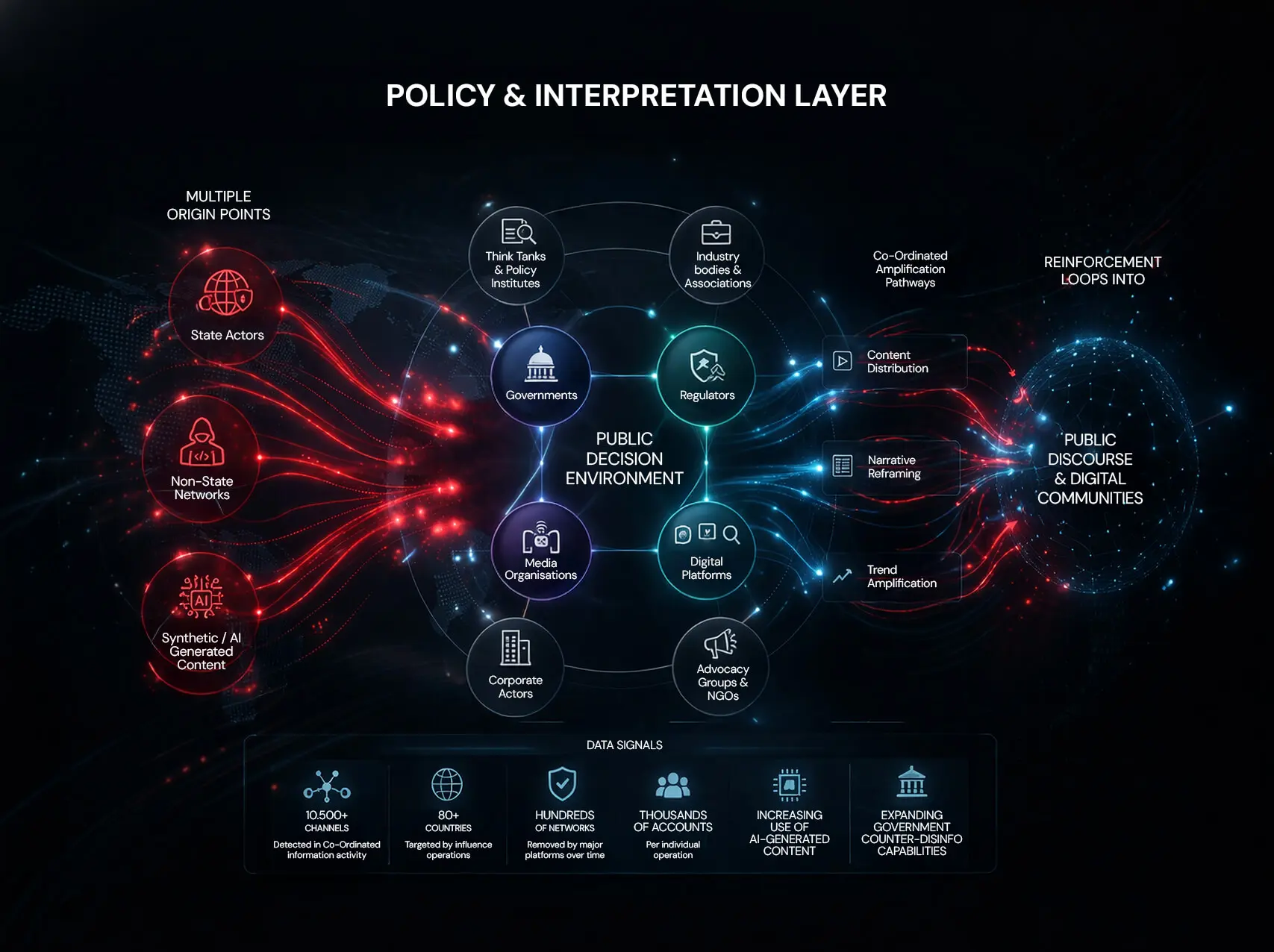
Information circulates across multiple layers. Signals are introduced, amplified, reframed and redistributed through networks that include state actors, media organisations, digital platforms, think tanks, advocacy groups and corporate actors.
This creates conditions in which multiple interpretations of the same issue can develop and persist simultaneously.
The structural nature of disinformation becomes more apparent when examined through its operational scale.
The presence of thousands of coordinated channels indicates that these activities are not confined to isolated actors. They are organised across networks that are designed to introduce narratives, sustain them and adapt them as they move across different environments.
These operations extend beyond political messaging. They increasingly engage with economic policy, regulatory developments, sectoral narratives and institutional credibility.
In this context, the objective is not only to misinform, but to influence how issues are framed and interpreted.
Narrative formation takes place across multiple layers.
Think tanks and policy institutes contribute through research outputs, analysis and commentary that shape early interpretation of complex issues. Industry bodies and corporate actors engage through advocacy, commissioned research and public positioning, influencing how developments are understood within sectoral and policy contexts.
These contributions are part of normal policy ecosystems. However, within a distributed information environment, they interact with coordinated campaigns, selective amplification and partial interpretation. This interaction can reinforce specific narratives or introduce bias into how issues are perceived.
Digital platforms act as distribution layers where content is circulated, reframed and amplified. Media organisations interpret and extend these narratives, while independent actors contribute to further dissemination.
This creates a system in which narrative formation is continuous and multi-directional.
Government responses have evolved accordingly. Several jurisdictions have established dedicated capabilities for monitoring information flows, identifying coordinated activity and responding to influence operations.
These include inter-agency units, regulatory frameworks focused on platform accountability and mechanisms for cross-border coordination.
Platform companies have also expanded their role. Meta Platforms reports ongoing removal of coordinated inauthentic behaviour networks linked to state and non-state actors, while Google has developed threat analysis and transparency initiatives focused on influence operations.
These measures indicate that information integrity is increasingly treated as part of system design and operational security.
Organizations operating within this environment often respond by increasing communication volume. In distributed information systems, this approach does not ensure consistent interpretation.
Messages can be reframed or selectively amplified as they move across networks.
More effective responses tend to align with how narratives are introduced and sustained. This includes monitoring early signals, engaging across multiple stakeholder layers and maintaining consistency across institutional, media and digital contexts.
Public decision environments are increasingly shaped by how narratives are constructed, reinforced and interpreted across interconnected systems.
The scale and structure of these systems indicate that disinformation is not an isolated phenomenon, but part of the broader architecture within which policy and institutional positioning evolve.
Sources
- European External Action Service — Threat Reports on Foreign Information Manipulation (2025)
- Meta — Coordinated Inauthentic Behaviour Reports (2024–2025)
- Google Threat Analysis Group — Influence Operations Bulletins (2024)
- NATO Strategic Communications Centre — Disinformation Analysis (2024)
News & announcements



What the ecb’s latest digital euro push could mean for trust and stakeholder confidence in payments




Global success stories

Strategic advocacy outlook 2026
Strategic influence, institutional trust and the future of advocacy

Asia semiconductor narrative 2026
Navigating geopolitical tensions in the global supply chain

Operating in real-time feedback loops
The evolution of information integrity and open influence ecosystems
Strategic advocacy outlook 2026
Strategic influence, institutional trust and the future of advocacy
Asia semiconductor narrative 2026
Navigating geopolitical tensions in the global supply chain
Operating in real-time feedback loops
The evolution of information integrity and open influence ecosystems
Explore industries

Energy, resources & circular economy
Operating at the intersection of policy, capital and public scrutiny, where perception shapes access, alignment and long-term positioning.

Financial services
Operating at the intersection of regulation, market perception and institutional trust, where capital flows are influenced as much by narrative interpretation as by financial performance.

Consumer & digital economy
Operating within fast-moving environments where perception, behaviour and platform dynamics directly influence growth, trust and regulatory response.

Defense & strategic industries
Operating within high-sensitivity environments where perception, compliance and institutional alignment determine long-term positioning and access.

Healthcare & life sciences
Operating across clinical complexity, regulatory oversight and public perception, where interpretation influences adoption, trust and treatment pathways.
Infrastructure & transport
Operating across long-cycle investments, regulatory oversight and public acceptance, where project viability is shaped by multi-stakeholder interpretation.

Public sector & sovereign institutions
Operating in environments where policy, perception and stakeholder interpretation directly influence national positioning, institutional credibility and international engagement.

Technology, media & platforms
Operating at the intersection of scale, regulation and public perception, where platform decisions, content ecosystems and policy scrutiny shape long-term positioning and market access.