
What defense-focused AI companies can learn from traditional defense contractors about communication
As AI enters defense environments, communication shifts from iteration to lifecycle-based interpretation
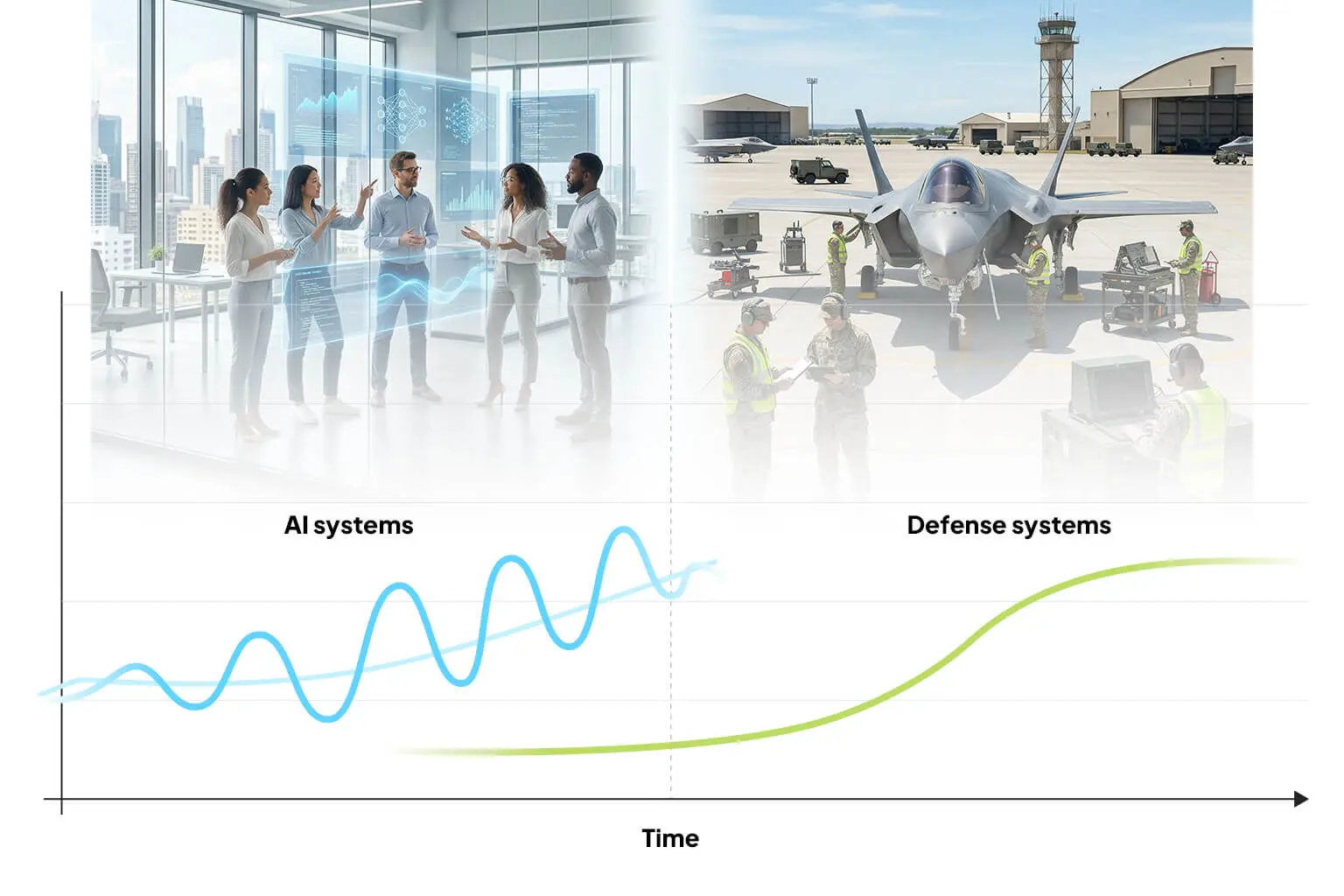
Defense system lifecycles
Major defense platforms are designed to operate across extended timelines with sustained oversight.
Global defense spending
Annual global military expenditure continues to expand, reinforcing long-term program structures.
AI systems are increasingly being developed for defense and national security environments. As this transition progresses, the conditions under which these systems are evaluated begin to align more closely with those that have long shaped traditional defense contractors. This shift influences not only how systems are built and deployed, but also how they are communicated and interpreted.
Defense systems are designed with the expectation that they will operate over long durations under defined and often demanding conditions. Development is followed by structured validation, staged deployment and continuous oversight. Communication is closely aligned with this lifecycle.
Capability is described in relation to how the system performs across time, how it integrates into existing infrastructure and how it is expected to behave under operational conditions. Information is presented with sufficient context to allow stakeholders across procurement, regulatory and operational environments to evaluate the system within a consistent framework.
This approach is reflected in how traditional contractors describe their role. Lockheed Martin has consistently positioned its programs around mission readiness and system reliability, while Boeing frames its defense portfolio in terms of lifecycle support, integration and operational capability. These formulations place emphasis on continuity and deployment context rather than isolated performance.
AI systems have developed within a different set of conditions. Development cycles are shorter, improvements are more frequent and capability is often communicated through benchmarks, updates and iteration speed. These signals are effective in environments where adoption is driven by performance and competitive differentiation.
This difference is visible in how leading AI companies communicate. OpenAI frequently frames progress through model capability improvements and iterative releases, while Anthropic places emphasis on scaling model capability alongside safety research. These approaches reflect a development-driven environment where progress is tied to iteration.
The difference between these environments is reflected in how capability is interpreted. In iterative environments, frequent change is associated with improvement. In lifecycle-based environments, consistency over time is used to assess reliability.
Stakeholders evaluating defense systems require clarity on how a system will perform across its operational life, not only how it performs at a specific point.
Traditional defense contractors align communication with this requirement. Systems are described with reference to their stage within the lifecycle, their validation status and their role within a broader operational structure. Capability is presented alongside constraints, integration pathways and expected performance over time.
This approach supports consistent interpretation across different stakeholder groups.
AI companies often communicate in ways that reflect development cycles. Performance improvements, model updates and new capabilities remain central to how systems are presented. When applied to defense environments, this can make it difficult to relate these signals to lifecycle-based evaluation criteria.
As a result, the same system may be interpreted differently depending on how it is assessed.
Where communication is aligned with lifecycle expectations, capability can be understood within operational and institutional contexts. Where alignment is limited, stakeholders may rely on signals that do not fully reflect how the system will perform over extended periods.
For AI companies operating in defense environments, this introduces a requirement to connect development cycles with lifecycle expectations. Communication begins to incorporate how systems behave over time, how they are validated and how they integrate into existing operational frameworks.
As these systems become part of defense infrastructure, they are evaluated not only for their capability, but for their consistency, reliability and alignment with institutional requirements over extended timelines.
Sources
- Stockholm International Peace Research Institute — Global Military Expenditure Report (2024)
- US Department of Defense — Budget and Procurement Data (2024–2025)
- NATO — Defense Spending and Capability Reports (2024)
- European Defence Agency — Capability Development Reports (2024)
News & announcements


What the ecb’s latest digital euro push could mean for trust and stakeholder confidence in payments



Global success stories

Strategic advocacy outlook 2026
Strategic influence, institutional trust and the future of advocacy

Asia semiconductor narrative 2026
Navigating geopolitical tensions in the global supply chain

Operating in real-time feedback loops
The evolution of information integrity and open influence ecosystems
Strategic advocacy outlook 2026
Strategic influence, institutional trust and the future of advocacy
Asia semiconductor narrative 2026
Navigating geopolitical tensions in the global supply chain
Operating in real-time feedback loops
The evolution of information integrity and open influence ecosystems
Explore industries

Energy, resources & circular economy
Operating at the intersection of policy, capital and public scrutiny, where perception shapes access, alignment and long-term positioning.

Financial services
Operating at the intersection of regulation, market perception and institutional trust, where capital flows are influenced as much by narrative interpretation as by financial performance.

Consumer & digital economy
Operating within fast-moving environments where perception, behaviour and platform dynamics directly influence growth, trust and regulatory response.

Defense & strategic industries
Operating within high-sensitivity environments where perception, compliance and institutional alignment determine long-term positioning and access.

Healthcare & life sciences
Operating across clinical complexity, regulatory oversight and public perception, where interpretation influences adoption, trust and treatment pathways.
Infrastructure & transport
Operating across long-cycle investments, regulatory oversight and public acceptance, where project viability is shaped by multi-stakeholder interpretation.

Public sector & sovereign institutions
Operating in environments where policy, perception and stakeholder interpretation directly influence national positioning, institutional credibility and international engagement.

Technology, media & platforms
Operating at the intersection of scale, regulation and public perception, where platform decisions, content ecosystems and policy scrutiny shape long-term positioning and market access.